The educational grant is awarded to physicians interested in anterior segment eye problems. Selected physicians under the age of 35 attended the congress ESCRS.

The ESCRS Congress is undoubtedly a huge event in the world of ophthalmology, attracting the biggest names in contemporary ophthalmology every year, such as Uday Devgan, Sergio Canabrava, Carlo Carlevale, and many others. This year, it took place in beautiful Copenhagen, which welcomed participants not only with an inspiring environment, but also with pleasant autumn weather, which was perfect for exploring the city after the professional program ended.
The program was exceptionally broad and packed, which also had a certain negative aspect in the form of poorer clarity – for effective participation, it is really necessary to plan a day in advance, otherwise one can easily get lost in the flood of parallel sections.
From a professional point of view, I was most interested in Professor Gatinel’s two lectures, which were devoted to multifocal lenses and, in particular, the way in which these lenses achieve their optical effect. It was a very accessible and practical look at a topic that carries a certain mystery with it.
I would like to thank the organizers for their support and care throughout the event—their approach greatly contributed to the overall positive impression of the congress. And, of course, last but not least, I would like to thank the CSRCS for the opportunity to participate in this educational event.
Thanks to a grant from a competition organized by CSRCS, this year I had the opportunity to attend the prestigious ESCRS 2025 international congress in Copenhagen for the first time.
The program was exceptionally high-quality and rich in topics, and it was often difficult to choose between concurrent sessions featuring excellent speakers. I took the opportunity to hear the latest scientific findings from clinical studies as well as practical advice and experiences from phenomenal surgeons such as Professors Dua, Osher, Barett, Devgan, and many others. This year, a separate section was created for young ophthalmologists and novice surgeons, which included useful practical tips not only from experienced doctors but also from residents themselves.
I focused my participation in the lectures on areas relevant to my professional direction and practice at our clinic. Among other things, I focused on cataract surgery and the treatment of complications from the perspective of a novice surgeon, and during other blocks I followed modern therapeutic approaches in the treatment of corneal diseases such as pterygium, keratoconus, and dry eye syndrome. The lectures on refractive surgery, which is undergoing incredible progress in all directions, were also very interesting. I also found the seminar on critical reading, which focused on the correct interpretation of published articles, to be very useful.
I consider my participation in the congress to have been very beneficial. In addition to my own notes and photographs from the presentations, I also gained access to some online educational materials, which I am already using. I also greatly appreciate the opportunity to establish contacts with other congress participants who are interested in the same field.
In addition to the professional side of things, I also really appreciate how the CSRCS organized the trip and stay in Copenhagen. Everything was top-notch, which allowed me to make the most of my stay. After the professional sessions, I made sure to set aside some time to get to know Copenhagen better, and there were many pleasant opportunities to meet colleagues from other workplaces.
In conclusion, I would like to say that my participation in the ESCRS Congress exceeded my expectations. I consider the experience I gained to be very beneficial for my future professional development, and I would like to continue participating in this congress in the coming years.

The first day of the congress was dedicated to glaucoma. The lectures were divided into blocks according to the basic examination methods for glaucoma – perimetry, OCT, optic nerve findings, and intraocular pressure measurement. Valid recommendations and current news were presented. I was particularly interested in a lecture on home visual field testing using the Eyecatcher program, which can be installed on a standard tablet. Although it does not yet match the quality of classic perimetry, the results are very promising for the future.
The ESCRS congress itself took place over the following days, offering a choice of lectures, workshops, and wet labs running in parallel in 20 halls. Some of them can also be viewed retrospectively in the mobile app. Among the most interesting were innovations in the treatment of limbal cell damage, 3rd generation accommodative IOLs, recommended treatment regimens for infectious corneal ulcers using PACK-CXL, and a new type of multifocal IOL with spiral optics.
Participation in the ESCRS congress was a great opportunity to learn about the latest technologies and methods in the field of cataract and refractive surgery. The congress not only offered valuable lectures and workshops, but also the opportunity to discuss with leading experts and gain inspiration for further work. We will apply the knowledge we have gained at our workplace, which will benefit our patients and contribute to the further development of our field in the Czech Republic.
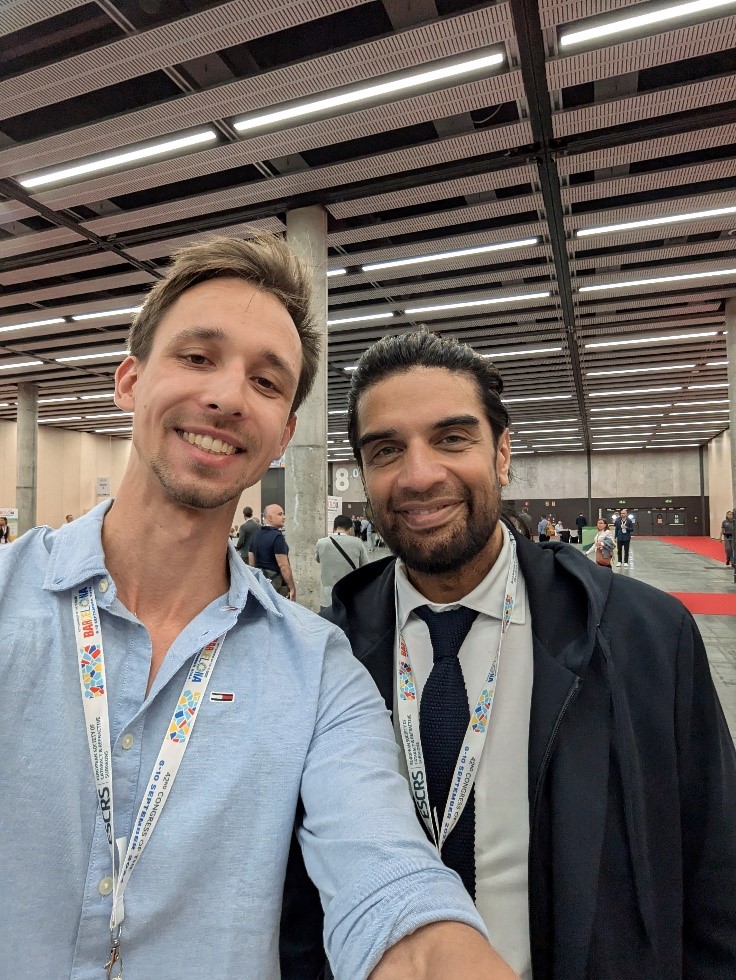
<< Jan Pohanka and Ike Ahmed
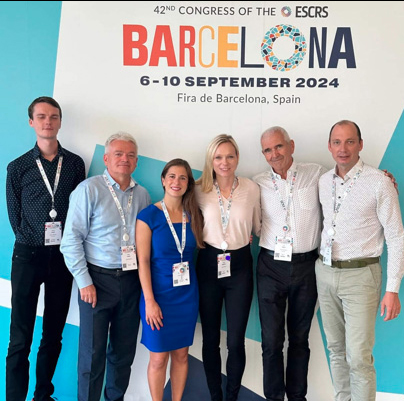
I attended the ESCRS Congress in Barcelona from Saturday morning to Monday afternoon. Neomed/Ewopharma organized everything perfectly, from the meeting at Prague Airport and hotel accommodation to the dinner we had together.
At the congress, I was very interested in the section on „managing complications during cataract surgery,“ which also mentioned Morgagni’s cataract. This is a type of hypermature cataract caused by liquefaction of the cortex and descent of the nucleus to the bottom of the capsule. It occurs mainly in developing countries with lower access to medical care. I have not yet encountered this type of cataract in practice, but the video and photo documentation presented were informative.
Another interesting topic was a surgical method called ROC – reverse optic capture. According to the presentation, this method can be used to treat symptomatic negative dysphotopsia, to prevent the rotation of toric intraocular lenses, or in cases of posterior capsule rupture to prevent lens dislocation.
It should be mentioned that there were many interesting topics and it was often difficult to choose which block to attend.
In conclusion, I would like to thank you for the opportunity to participate in an international congress abroad. It was a unique opportunity to expand my knowledge, but also a chance to meet and get to know new colleagues.